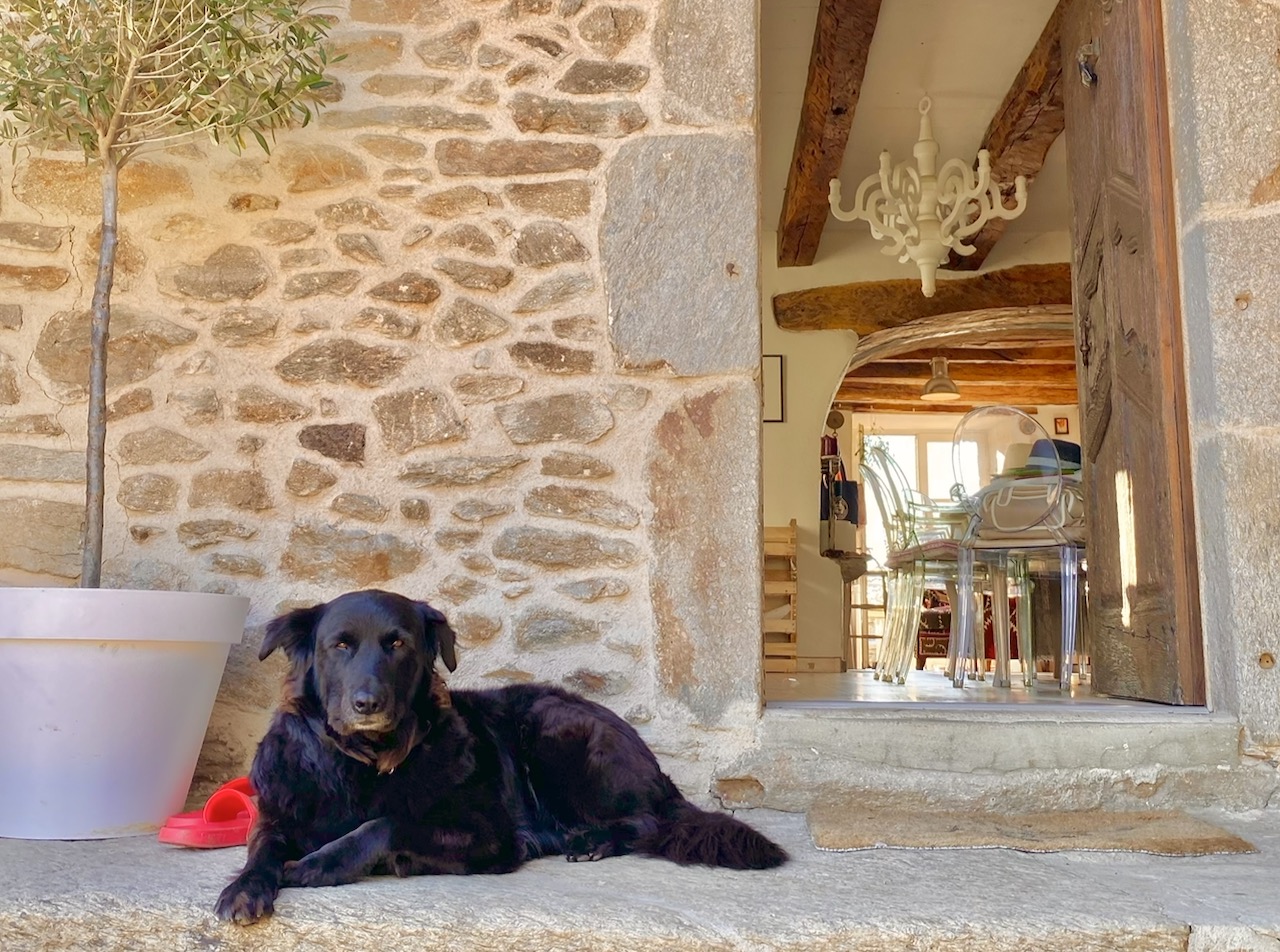
Hello – Where is your buddy taking you this summer
Since May last year the EU and UK have been actively discussing a “Common Veterinary Area”. At York Street we were optimistic that by now we would once more have a Pet Passport recognised by the EU. But as of last month, pet travel for some has become more exasperating.
Pet Passports issued to UK pets are no longer valid. If you live in the UK your pet now needs an Animal Health Certificate (AHC) each time you visit the EU.
Visit https://londonvetclinic.co.uk/pet-travel/ for general information about taking your dog, cat (or ferret) abroad.
Visit https://londonvetclinic.co.uk/pet-travel/travel-to-the-eu-including-ireland-switzerland-norway/ if you’re visiting the continent and complete this application form.
Once we have the information you provide we’ll apply to DEFRA for the AHC, on your behalf. As a reminder, pets must be microchipped and rabies vaccinated at least three weeks before entering the EU.
Paloma, Bruce, Adam and Stephen are all “Official Veterinarians” or “OVs” and may legally sign certificates on the UK government’s behalf. The EU does not allow a non EU vet to enter rabies vaccination details in an EU issued passport.
For more information on pets traveling abroad read this month’s blog, Taking pets abroad.
Summer in France
The team has its own What’s App chat groups
We have two WhatsApp chat groups at York Street. The first is the vital one: who is stuck in traffic, what delivery is delayed, reminders about the colour-codes for waste (orange, red, yellow, purple, blue, tiger stripes, grey, clear) or updates on clinical guidelines.
The second is for fun. These postings are mostly pictures of us, what we get up to during the day. Here’s Dolly at work.
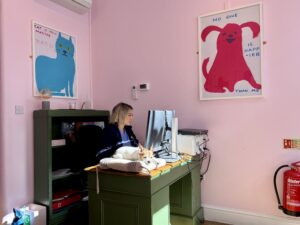
Pops soaks up the sun while Dolly works.
And here’s Amy working.
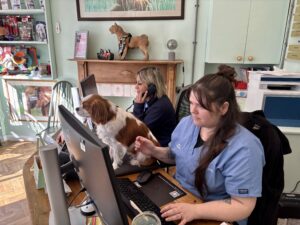
Amy’s assistant tells her when someone if about to visit Reception.
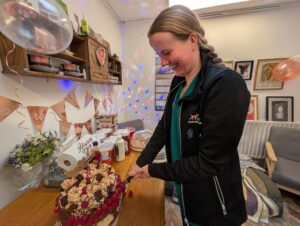
Jess cuts into her birthday cake, baked by Sophie. (Room decorations are by Dolly.)
Here are two more candid photos from our WhatsApp chat group, that Sophie’s fellow nurses took of her while she was quietly communicating with visitors You meet Sophie in Nurses Consults when she does post-op checks or when she helps vets in consults or helps the Reception team. But this is how Sophie spends most of her time, with patients.
Sophie is Australian and like Adam from the USA, me from Canada and Natalia and Paloma both from Spain, we all like the British weather! Sophie’s back story is in marketing. We’re probably the last clinic in the UK to have a social media presence and while Sophie has explained to us why it should be planned and professional she has also gently added that marketing is what she did in a previous life but what she’s doing in these pictures is what she finds most rewarding.
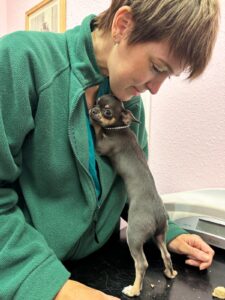
Visitors feel secure with Sophie.
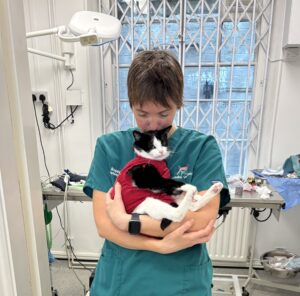
After her operation our visitor gets an extra cuddle from Sophie.
The importance of a healthy mouth
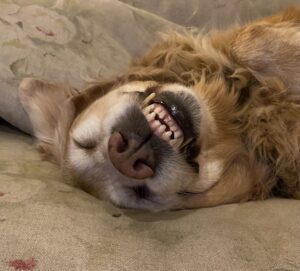
Stephen and I were patting ourselves on the back, reminding each other how good we are at making pets better without drama, without putting them through lots of ‘stuff’ when Stephen said, “but we really could be better reminding people more, how important it is to keep mouths healthy.
Stephen was right. When we show you “gingivitis” or “plaque” or “periodontitis” in your cat or dog’s mouth we know that you understand this is a problem and would have it attended to if it were happening in your mouth but then, when you express your reservations about an anaesthetic (Proper scaling and polishing usually takes over an hour.) we usually say, “Let’s have a look again in a few months.”
That’s wrong! When we see a medical problem that will only get worse but is simple to correct, we should spend more time encouraging you to get it resolved. We should be reminding you that we would never suggest anaesthesia is we thought it was risky. (The horror stories that appear on Socials look impressive but are scarily, dangerously untrue. Don’t believe them.)
At York Street we are very experienced in and have the sophisticated equipment needed to provide healthy mouth care. For example dental x-rays reveal tooth damage below the gum line. And scaling and polishing below the gumline is the key to curing gingivitis. Scaling the visible tooth makes the tooth look nice but does not cure gingivitis or arrest periodontitis. We see dogs that have routine twice yearly ‘dentals’ at the groomer that have such advanced periodontitis that we can no longer save their teeth.
For any dental procedure there are usually two vet nurses assisting the vet. One is the anaesthetic nurse (and you may remember that Head Vet Nurse Jess Sproate has an advanced qualification in anaesthesia.) and the other is the dental assistant.
Occasionally, unusual dental procedures are needed and when they are these are done at York Street, without the need for travel to a referral hospital by our dentist Peter Kertesz who has over 40 years of experienced in animal dentistry (and who wrote the first textbook on comparative dentistry.)
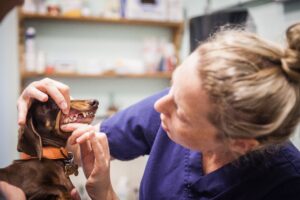
We regularly check the teeth and gums.
Please read more about how to prevent bad breath, gum disease or tooth loss: How to Keep Teeth and Gums Healthy.
STOP PRESS
Grass seeds are creating early summer havoc
Arrow-shaped seed heads from wild barley, brome grass and meadow foxtails are drying early this year. They get between dogs’ toes, in their ears, eyes, nose or through their skin then migrate forward, never back. They don’t break down.
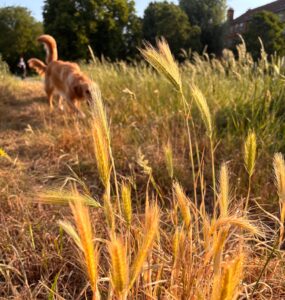
These are drying seed heads still on their stems. Individual seeds penetrate the skin. Look for them on your dog after every walk.
Beetle moved to Brighton some time ago but we encourage families who have moved away from London to keep in touch. Beetle’s local vet was concerned that a small swelling under her jaw might be ‘cancer’. Beetle’s ‘mom’ contacted us and we explained that in a three year old Lab, either an abscess or a saliva cyst were more likely but a cancer was always possible.
The vet took a biopsy and sent it for analysis but by Saturday morning Beetle’s face had swelled so much her tongue was sticking out and she found it hard to stand or walk.
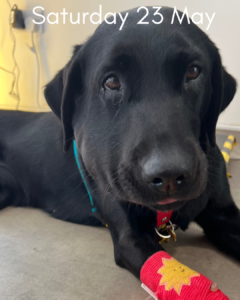
This is Beetle, Saturday morning. She had a deep sedative on Friday. That’s why she has a bandage on her leg.
It was the holiday weekend. The local vet agreed that because Beetle had deteriorated so suddenly she needed a referral and we suggested The Ralph in Marlow. The primary vet’s concern was ‘cancer’ but fortunately a CT scan ruled that out. When the swelling was opened and cleaned out the surgeon found a grass seed. Beetle was back home and her normal self by Monday evening.
At York Street we’ve already seen a golden retriever with a grass seed abscess between her toes. So from now until September when what are variously called ‘grass seeds’ or ‘foxtails’ or ‘plant awls’ have softened and are no longer a danger, after every visit to parks, road verges or meadows please examine your dogs, especially between their toes and under their ears, for any nasty seeds they’re collected.
I still let my dogs race through meadows
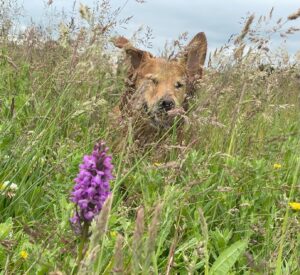
My dogs Plum and Honey enjoy racing through Sussex meadows but get checked over after each romp.
Until next month…