Domestic cats arrived in Europe much later than we thought
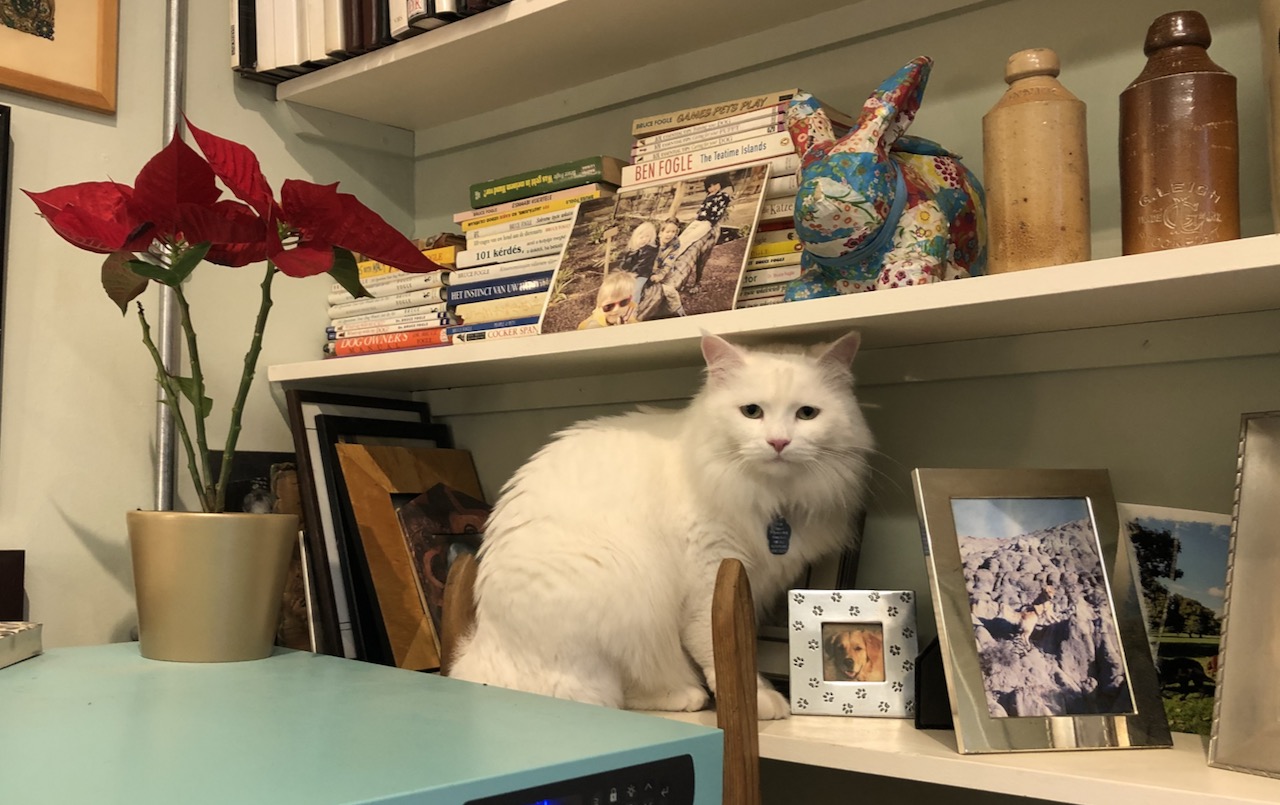
This is Audrey. Audrey is affectionate, enjoys the company of people, and dogs, asks to be stroked, browbeats her person when she’s hungry and generally treats people as if we are her interns. She is the epitome of thousands of years of careful cat domestication. But she isn’t. Recent genetic evidence reveals that Audrey’s ancestors were domesticated after Hadrian’s Wall was built, less than 2000 years ago.
Audrey is a typical domestic cat, comfortable living a safe and satisfying indoor life.
This is new news. Until recently we thought that the domestication of the African wildcat (Felis lybica) happened over 7000 years ago. There was archeological proof and on page 24 of The New Encyclopedia of the Cat I wrote, “In mapping the spread of the cat, one of the most significant finds comes from a tomb in Cyprus, thought to be the remains of an African wildcat, Felis lybica, dating from about 5000 BC.”
But a just published DNA analysis says this skeleton is not an African Wildcat, Felis lybica but that of the never ever domesticated European wildcat, Felis sylvestris.
New DNA evidence has also emerged in China where cat remains from 5000 years ago were also thought to be from a descendant of the African wildcat, Felis lybica. DNA analysis shows that it is the physically similar but completely different species, the never domesticated leopard cat (Prionailurus bengalensis). Descendants of Felis lybica arrived in China only 1300 years ago. Their ancestors came from the Middle East and Central Asia, travelling along the Silk Road.
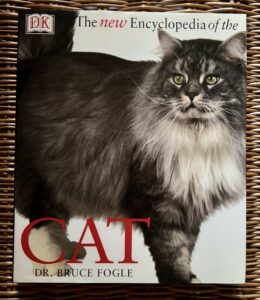
Bruce wrote this encyclopedia 30 years ago and it’s still a good source of cat information.
The DNA researchers studied material from hundreds of archeological sites and museum specimens throughout the world. All the old specimens are genetically the never domesticated Felis sylvestris, the European Wildcat. The earliest African Wildcat (Felis lybica) or domestic cat (Felis catus) is from 200AD in Sardinia. That means the dispersal of domestic cats throughout Europe and Asia occurred much later than previously thought. All domestic cats everywhere in the world, British Blues, Maine Coons, Norwegian Forest Cats, Turkish Vans, Siamese and Burmese, Singapuras, Japanese bobtails descend from just two genetically distinct populations of African wildcats.
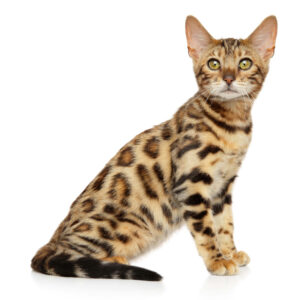
The modern Bengal was created by crossing domestic cats (Felis Catus) with wild leopard cats (Prionailurus bengalensis). That’s why they can be so feisty.
If you share your home with an exquisite Bengal, you already know it was developed by crossing domestic cats (Felis catus) with leopard cats (Prionailurus bengalensis). Individuals that are seven or more generations from the first cross usually have very reliable temperaments. You may also know that Bengals, just like Maine Coons, are prone to a heart condition called hypertrophic cardiomyopathy, where thickened heart muscle reduces the space for blood. Grant Petrie, our resident “CertCard” or Certificate in Cardiology vet routinely does preventative simple ultrasound examinations of cats and dogs hearts and starts medical treatment when needed.
We finally got a photo of Jen
There are some of you who may remember pre-1985 when the London Vet Clinic was five streets away on Seymour Street and the sole veterinary nurse was Jenny Berry who eventually became Jenny Ward.
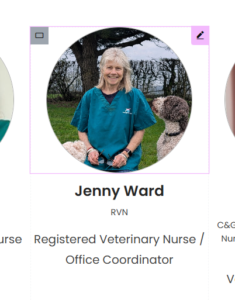
Jen was the clinical nurse but also the clinic’s do everything. If cats or dogs needed to be corralled in a photo studio for photographs for one of Bruce’s books, Jenny was there with bribes. She arrived at the clinic each day with her Italian Spinone and introduced some of you to them. She did the same when she added Lagotto to her home. After Jen moved to Herefordshire (She can see Wales from her kitchen window.) she continued as part of the team working from home. Jenny helps you with your insurance claims, manages the website, answers your telephone queries and is our resident library of knowledge about everything. Jennifer Ward has been part of the London Vet Clinic for almost 50 years and finally, thanks to Amanda (the clinic’s manager) who spent a few days with Jenny last month, there’s a picture of her, not just of her dogs, on the website.
Thank you for your thoughtfulness to the York Street team
Fortunately, with the depth of experience at York Street we’re usually pretty good at what we do but we always want to hear from you personally when you think we can improve what we’re doing. It’s natural to expect excellent service so we don’t expect to hear from you when you’re happy with what we do but when you do go out of your way and thank someone it’s so gratifying for the team. So please bear with me as I recount a really delightful recent Google review that captures what we do.
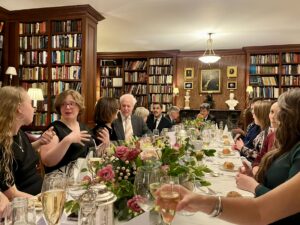
The York Street team cleans up nicely! Here we are at our annual post Christmas dinner.
”Fernando and I genuinely couldn’t recommend this clinic more highly.
Firstly, they now have the best and most glamorous vet in the world in Paloma, but they also combine world class clinical care with a front-of-house team that somehow manages to be ultra efficient, warm, fun and just the right amount of feisty. We genuinely love you Amy, Faith and Dolly. You make what can sometimes be a stressful visit feel human, relaxed and even enjoyable.
What stands out here is the atmosphere. This isn’t a conveyor-belt clinic. You feel cared for from the moment you walk through the door. The team knows the animals, remembers the people and treats both with real kindness and personality, which is rarer than it should be.
Then there’s Bruce’s artwork and the wonderfully eccentric Marylebone setting, which gives the whole place real character. Somehow they’ve managed to create a space where sometimes difficult moments feel lighter and where you leave feeling reassured rather than drained.
Professional, compassionate and completely authentic. If you want a vet practice that combines serious expertise with genuine humanity, this is it.
Highly recommended.”
Thanks Martin for such warm and thoughtful words.
If you are happy with the care that any of the team provide you and your buddies, please feel free to leave a review by scanning this.

We have revived an old tradition
While some of us were reminiscing about changes that have taken place in veterinary medicine, one of our referral vets lamented the loss of brass name plaques at vet clinics. “It’s all video screens now.”, the referral vet explained.
So with the help of some creative sign makers in Devon, everyone at York Street – the reception team, nurses, general practice vets and referral vets, -now has his or her own hand made brass name plate. Here they are:
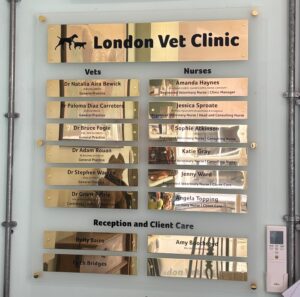
There are brass name plates in 86 York Street for all the reception team, nurses and general practice vets.
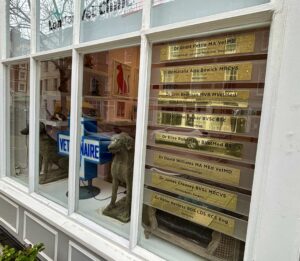
In the window of 84 York Street are name plates for each of the referral vets.
And finally
There are two new blogs on the London Vet Clinic’s website this month.
Hearing Dogs for Deaf People is 44 years old this month.
Find out more about the charity that Bruce founded.
Is Petfood Safe?
Read the first blog on feeding pets. There will be another one next month.