Advances in diagnostics and treatments such as those we use at the London Veterinary Clinic are there to extend the lives of our pets. All of us here have our own pets. We feel that ‘quality of life’ is almost always far more important than ‘quantity of life’.
The moral dilemma this brings is:
How far should we go using modern technology advances?
They have no say in decisions we are making to prolong their lives.
They have no say in the decisions we are making about their treatment.
They have no say in the decisions we are making about their treatment.
Is it fair to continue treatment when a cure is not possible?
Can we be sure that what we think of as 'treatment' is not equivalent to 'medical assault?
How do we make a safe decision?
Understanding Your Pets Treatment Options
Two pets may have identical conditions but their circumstances may suggest two opposite decisions. For example, a goofball dog that loves visiting the vet’s because he or she gets food treats and cuddles is an ideal candidate for weekly intravenous chemotherapy while a fretful, anxious individual may not be. There are no black and white answers when we’re faced with these hard decisions. Put in crude financial terms we have no interest whatsoever in deriving income by undertaking treatments that distress pets. We feel these are morally wrong. Sometimes, a little short term distress or upset may be worth enduring if the outcome is a more than commensurate enhancement of life. Whatever the circumstances, we will help you through with your decision-making. At the London Veterinary Clinic, small as we are we have an Ethics Group, with cumulatively far in excess of one hundred years of clinical experience, that oversees the decisions you and we make concerning on-going treatments for your dog or cat.
Surgery
General Surgery
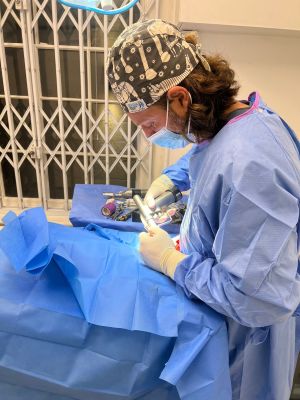
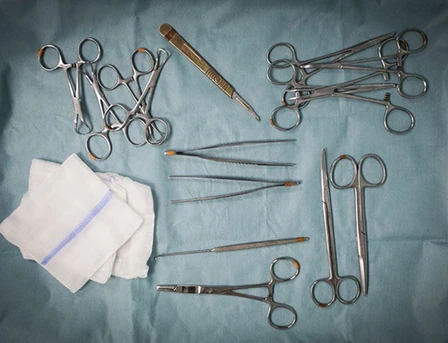
Our vets Stephen, Paloma and Adam, undertake all routine surgery with pets returning home the same day. Additional surgical expertise is provided at York Street by the consultants Grant, David, John, James, Erin and Elise. Overnight hospitalisation is rarely needed but when it is it is provided by Veteris in Shoreditch.
Surgery for Senior Pets
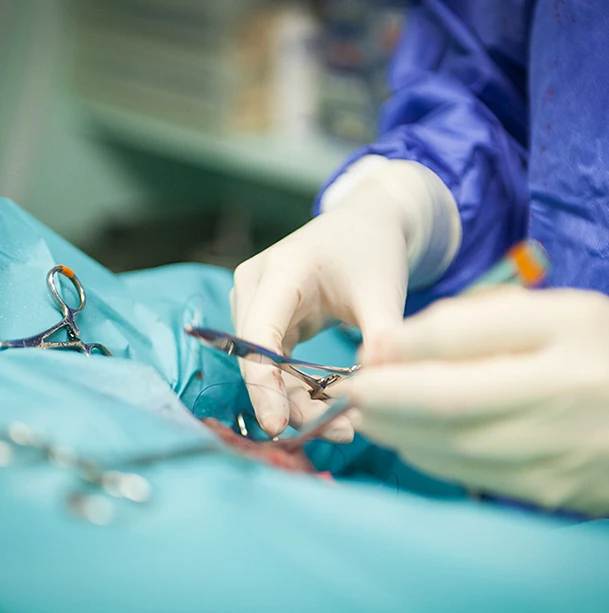
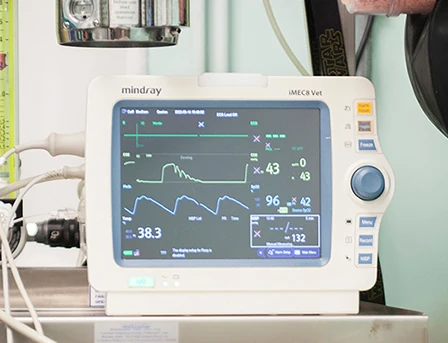
The anaesthetics and drugs we use during surgery together with the methods we use to monitor vital signs are comparable to those used for us when we have hospital operations. Continuous monitoring includes blood pressure, electrocardiogram, oxygen saturation, carbon dioxide levels, and ventilation. With the skill of our staff, it is ‘normal’ for us to successfully operate on very old, very sick animals that have a multitude of medical problems. While we never take the administration of a general anaesthetic casually, anaesthetic complications are rare despite the sometimes severe nature of the problems we manage.
Dentistry
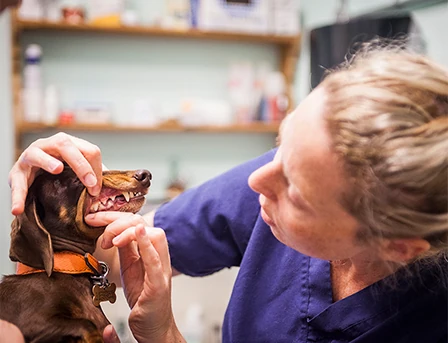
Dentistry at London Vet Clinic
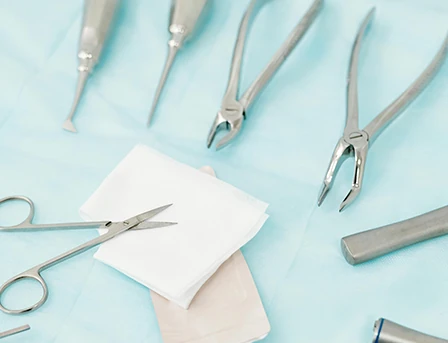
Preventing tooth and gum disease is vital and when you visit us we explain how to keep your companion’s mouth, teeth and gums healthy. The reality is, however, that oral problems are common and because they are we are experienced in and have the sophisticated equipment needed to provide successful care. Dental x-rays are particularly important to help reveal tooth damage below the gum line. Dental extractions when necessary, scaling and polishing, are all time consuming procedures. There are usually two vet nurses assisting the vet with each dental.
Occasionally unusual dental procedures are needed and when they are these can be done at York Street, without the need for travel to a referral hospital by our dentist Peter Kertesz who has over 40 years of experienced in animal dentistry (and who wrote the first textbook on comparative dentistry).