
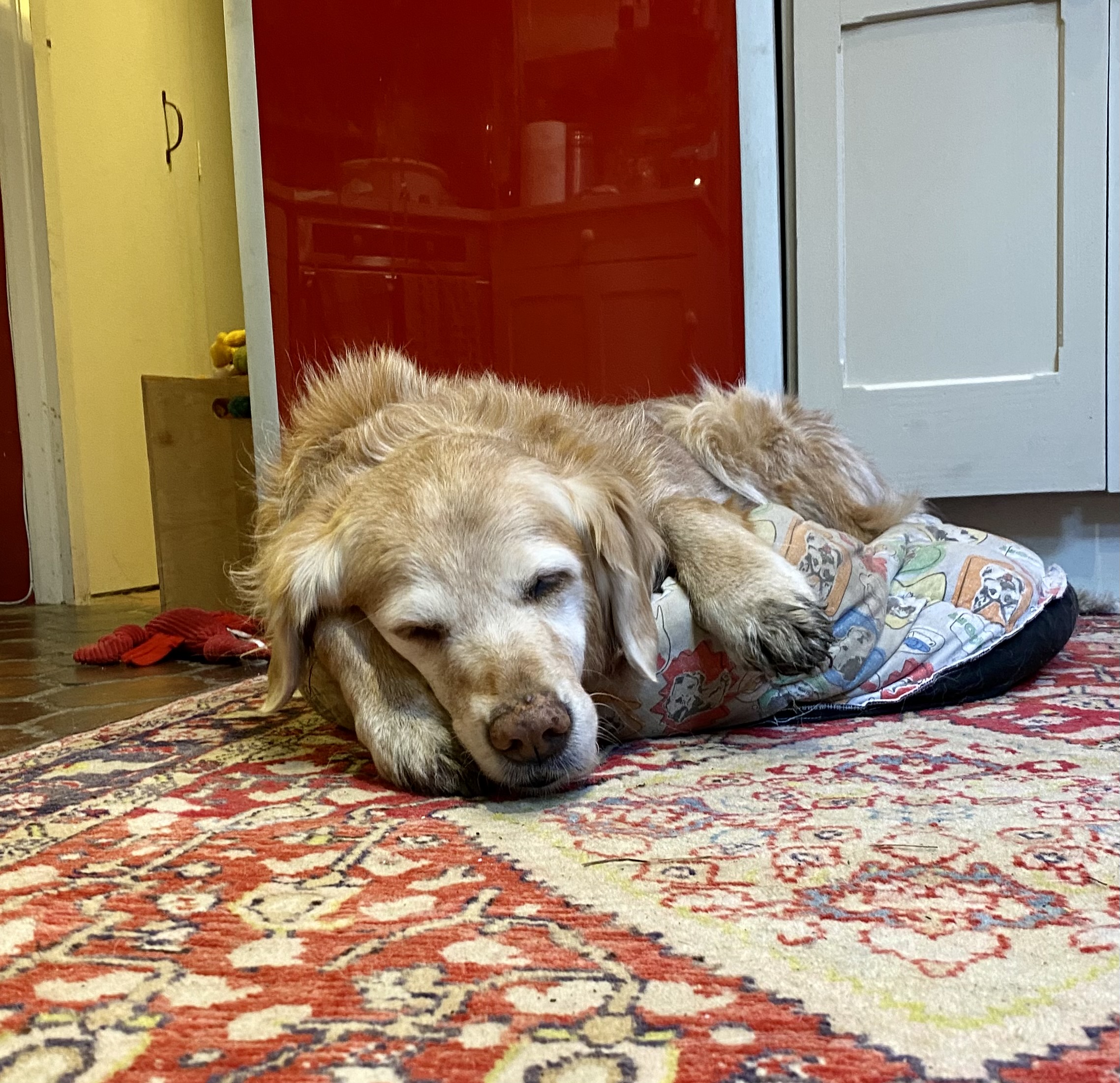
Dogs and cats are living longer than ever and senility is a diagnosis of exclusion. There are medical reasons for pets becoming disorientated or soiling in the house, or becoming less active or reducing their interactions with people or having sleep changes. But when a cat or dog behaves in these ways and we have eliminated reasons such as inflammations, cancers, endocrine disorders or pain then we can presumptively diagnose an age-related decline in the brain’s previous abilities, in ‘cognition’. This is what dementia is.
Robert Frost’s poem, “The old dog barks backwards without getting up. I can remember when he was a pup.” is both haiku-perfect and brilliantly accurate in describing canine old age. I live with one and a half year old Honey and 12 year old Plum but also enjoyed the company of Bean, Plum’s mother (and Honey’s grandmother) for well over 16 years. In her latter days Bean didn’t bark for seemingly no reason. She wasn’t irritable or clingy, but her sleep-wake cycle went mildly out of kilter. She’d get up at 2 AM, wander out of our bedroom, in and out of the bathroom, then go downstairs. I’d find her in the living room or kitchen in the morning. Each evening between 7 and 9 PM she became restless and couldn’t settle. She wandered in and out of the hallway and absently licked me (or the sofa!). But this was self-limiting. And, thank goodness, her control of her bladder and bowels remained Olympian until the last months of her life. Then she’d pee on the carpet rather than go to the back door, or poop in her sleep. I. know so many of you who have responded as we did. We simply cleaned up after her.
The University of Sydney created a scale to help you determine if your dog has signs of senility or what it calls ‘Canine Cognitive Dysfunction’. Here it is.
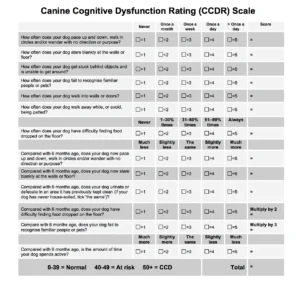 I applaud them for their attempt but personally find scoring only moderately useful.
A protein called beta-amyloid is found on post mortem in elderly dogs with dementia. Both drugs and diets are being investigated to see if either can slow down the development of this damaging protein. Hill’s Pet Nutrition product b/d (Brain Diet) and Purina’s Neurocare are foods they say improve learning ability and memory in senior dogs. Both can be purchased online or from the clinic.
10 changes that I associate with natural aging:
Confusion in familiar surroundings
Changes in sleep patterns
Decreased activity levels
Loss of house training
Changes in social interactions
Restlessness, pacing, more panting or agitation for no obvious reason
Decreased responsiveness
Changes in eating or drinking habits
Repetitive behaviours such as pacing
Loss of learned behaviours
I applaud them for their attempt but personally find scoring only moderately useful.
A protein called beta-amyloid is found on post mortem in elderly dogs with dementia. Both drugs and diets are being investigated to see if either can slow down the development of this damaging protein. Hill’s Pet Nutrition product b/d (Brain Diet) and Purina’s Neurocare are foods they say improve learning ability and memory in senior dogs. Both can be purchased online or from the clinic.
10 changes that I associate with natural aging:
Confusion in familiar surroundings
Changes in sleep patterns
Decreased activity levels
Loss of house training
Changes in social interactions
Restlessness, pacing, more panting or agitation for no obvious reason
Decreased responsiveness
Changes in eating or drinking habits
Repetitive behaviours such as pacing
Loss of learned behaviours
 Possible treatments for dementia
I gave Bean a drug called Vivitonin (propentofylline) that increases the lungs’ ability to take up oxygen. In theory a well oxygenated brain functions better. If she had anxiety-related sleep disorders I’d have given her an anti-anxiety drug, Natalia Bewick is one of the most experienced vets in general practice who uses these medicines so I would ask Natalia for her advice. I gave Bean a nutritional supplement called ‘Aktivait’, claimed by the manufacturer to ‘support brain function’. I once showed this product to a clinical pharmacologist who said, “This is a better combination than anything I’ve seen on the supplement market for people, but the quantities of the ingredients are too small to be effective.”
The bottom line is the same with dogs as it is with us. “Use it or lose it.” applies to us both. Bean continued to exercise twice a day, had play sessions and was given new and different toys. I stuck to predictable routines but knew that ultimately, just as it is for me, there’s no treatment for old age.
If you’re worried about behaviour changes in your older companion please contact us at 02077232068. More often than not there’s a physical reason for these changes, such as pain ,that can be managed through medicines, activity and diet changes.
Possible treatments for dementia
I gave Bean a drug called Vivitonin (propentofylline) that increases the lungs’ ability to take up oxygen. In theory a well oxygenated brain functions better. If she had anxiety-related sleep disorders I’d have given her an anti-anxiety drug, Natalia Bewick is one of the most experienced vets in general practice who uses these medicines so I would ask Natalia for her advice. I gave Bean a nutritional supplement called ‘Aktivait’, claimed by the manufacturer to ‘support brain function’. I once showed this product to a clinical pharmacologist who said, “This is a better combination than anything I’ve seen on the supplement market for people, but the quantities of the ingredients are too small to be effective.”
The bottom line is the same with dogs as it is with us. “Use it or lose it.” applies to us both. Bean continued to exercise twice a day, had play sessions and was given new and different toys. I stuck to predictable routines but knew that ultimately, just as it is for me, there’s no treatment for old age.
If you’re worried about behaviour changes in your older companion please contact us at 02077232068. More often than not there’s a physical reason for these changes, such as pain ,that can be managed through medicines, activity and diet changes.
I applaud them for their attempt but personally find scoring only moderately useful.
A protein called beta-amyloid is found on post mortem in elderly dogs with dementia. Both drugs and diets are being investigated to see if either can slow down the development of this damaging protein. Hill’s Pet Nutrition product b/d (Brain Diet) and Purina’s Neurocare are foods they say improve learning ability and memory in senior dogs. Both can be purchased online or from the clinic.
10 changes that I associate with natural aging:
Confusion in familiar surroundings
Changes in sleep patterns
Decreased activity levels
Loss of house training
Changes in social interactions
Restlessness, pacing, more panting or agitation for no obvious reason
Decreased responsiveness
Changes in eating or drinking habits
Repetitive behaviours such as pacing
Loss of learned behaviours
Possible treatments for dementia
I gave Bean a drug called Vivitonin (propentofylline) that increases the lungs’ ability to take up oxygen. In theory a well oxygenated brain functions better. If she had anxiety-related sleep disorders I’d have given her an anti-anxiety drug, Natalia Bewick is one of the most experienced vets in general practice who uses these medicines so I would ask Natalia for her advice. I gave Bean a nutritional supplement called ‘Aktivait’, claimed by the manufacturer to ‘support brain function’. I once showed this product to a clinical pharmacologist who said, “This is a better combination than anything I’ve seen on the supplement market for people, but the quantities of the ingredients are too small to be effective.”
The bottom line is the same with dogs as it is with us. “Use it or lose it.” applies to us both. Bean continued to exercise twice a day, had play sessions and was given new and different toys. I stuck to predictable routines but knew that ultimately, just as it is for me, there’s no treatment for old age.
If you’re worried about behaviour changes in your older companion please contact us at 02077232068. More often than not there’s a physical reason for these changes, such as pain ,that can be managed through medicines, activity and diet changes.