
Welcome to Spring
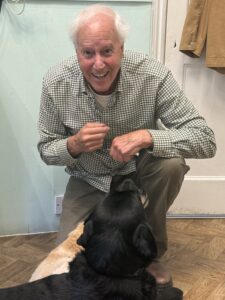
Our new team members
You often see Poppy, Jess’s part Chihuahua, part Jack Russel terrier either sleeping on the reception desk, or resting on a cushion in an opened drawer. Adam’s Bosnian buddy Bodie is more of a fixture in the staff room. Bodie keeps seats warm and, to the minute, anticipates his lunchtime walks. We now have two new members of the York Street family, who you may meet when visiting.
Amanda’s long haired miniature Dachshund Otter made his first visit to York Street in December. Otter who is now approaching six months old meets and greets when you visit 84 York Street. On the train in from Surrey to York Street each morning he has an inclination to climb on other passengers’ laps for a quick kip.
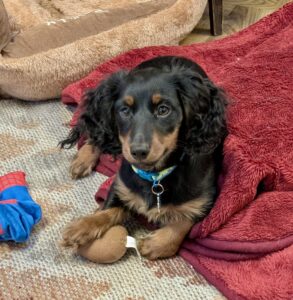
Otter has taken ownership of the Behaviour Play Room at York Street.
Sophie’s Jack Russell / Chihuahua mix Enid joined us in January. Little but powerful! We’re amazed that she doesn’t fall over when she o vigorously shakes her chew toys The two pups are of course, on the same wavelength so may we send our apologies if occasionally, the York Street floor becomes a Formula One racing circuit.
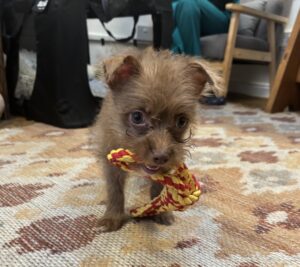
Enid is self-operating. She amuses us as much as she amuses herself.
Spring means parasite prevention both here and when travelling abroad
It’s meteorological spring in the UK. Growing up in Toronto, March was the month that arrived like a lion and departed like a lamb. It’s much less dramatic here in Central London but this is the month that nature awakens, and that includes our pets’ parasites becoming more active as the land warms.
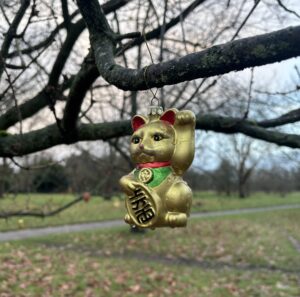
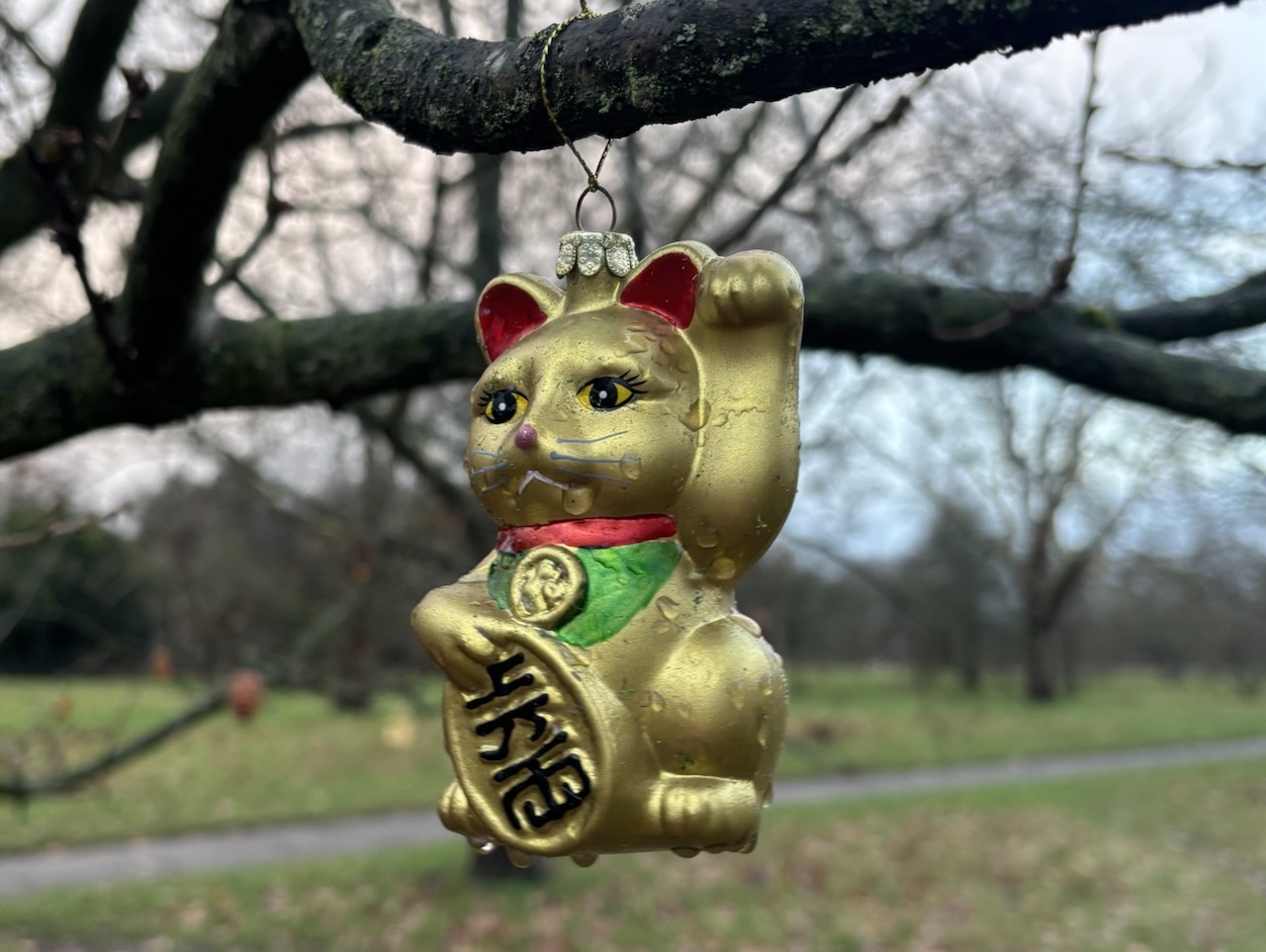
If you visit Hyde Park in March, look for the tree still decorated with Christmas ornaments, including this maneki-neko. beckoning you good luck and prosperity.
Cat parasites
Let’s start with the simplest prevention. Most cats we meet live comfortable indoor lives. While Google AI says “Fleas can easily hitch a ride on you or your visitors .” in truth hitchhiking is possible but in London very, very unlikely. At the London Vet Clinic we do not default to “full parasite cover” If you live with an indoor cat. We suggest a parasite prevention approach that is appropriate for what the risks really are. If your master of the universe goes outdoors, year round parasite prevention is usually the most sensible option. If you are travelling with your companion we’ll give you specific advice according to where you’re travelling to.
Dog parasites
All the dogs we meet have regular daily exercise in London and some have add-on time in the countryside. A dog’s risk of parasites is influenced by many factors.
Lifestyle has a considerable influence on parasite hazards. Exercising on grass or in woodland rather than on hard surfaces increases risk. So do day care centres or travelling together with dog walkers’ other dogs.
Diet and scavenging affect risk. Eating offal or raw food, or grass grazing and accidentally consuming small snails or slugs increases tapeworm, protozoal and lungworm risks.
Urban foxes share their parasites with dogs. If your buddy spends time where foxes are active the risk of parasites increases.
Travelling abroad usually means greater parasite risk. Folkstone and Calais may be only 30 miles apart as the crow flies but the risk of tick transmitted Lyme Disease increases tenfold when you reach the continent.
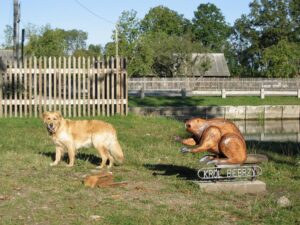
In the Baltic States and Poland, there is a higher incidence of tick-transmitted disease than in the UK and Ireland.
We can screen for parasites after travelling abroad
If you plan to travel to the continent or elsewhere this summer we will give you parasite prevention advice according to where you are visiting. Throughout the Mediterranean including far inland, sandflies transmit a very difficult to treat disease called Leishmaniasis. Mosquitos can transmit heartworm and ticks pass on a variety of serious conditions. We will give you prevention advice and through blood samples can screen for many of these conditions after you return to London.
Screening when recurring diarrhoea occurs.
Several parasites but especially the single-cell microscopic parasite Giardia can cause recurring diarrhoea. We can test for these parasites by examining poo samples, preferably from a pooled sample from three poos over three days.
If you have any specific questions about either travelling abroad or about at home parasite risk and prevention, visit our website:
or book a telephone consultation with one of our vets.
The referral vets are here to help
Many of you know that in 2024 we swapped the flat above 86 York Street for the shop next door at 84 York Street. That gave us another quiet reception area and exam room on the ground floor but as well, another prep room, cat day care room and operating room (and back garden). That’s why we have been able to invite referral vets to see you at York Street rather than sending you to them.
For example, Dr Elise Robertson is one of the country’s most experienced ‘keyhole’ surgeons. The Royal College of Veterinary Surgeons awarded Elise “Fellow” of the RCVS for her contribution to veterinary endoscopy education. Elise exemplifies the depth of experience our referral vets provide. She visits to undertake minimally invasive investigations of organs, endoscopic treatments in sinuses and ears and most frequently to do ‘keyhole’ spays. General Practice vets can easily learn the rudimentary techniques and undertake keyhole spays but we prefer that one of the most experienced vets in the UK provides you with her proficiency and skills.
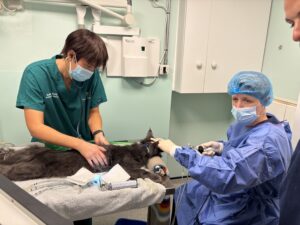
Elise, assisted by Sophie (Enid’s person), and watched by Adam, successfully treats a cat’s fungal infection by instilling the antifungal medicine through a tiny endoscope exactly where it’s needed, in the infected sinus.
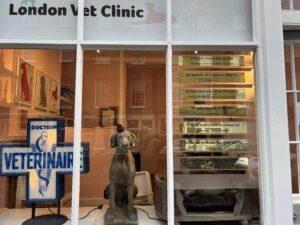
At York Street there are eight experienced referral vets available to help you and your companions.
Post Script
St Mary’s School children learn what vets do
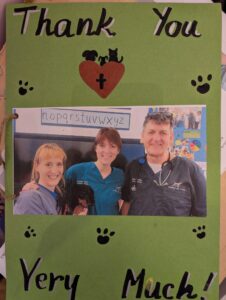
The reason there are so many tennis balls on the flat roofs behind the ground floor exam rooms is because St Mary’s School playground is behind the clinic. Yes, a high fence should prevent tennis balls from escaping but it doesn’t. In February, Grant (Head Referral Vet), Amanda (with young Otter) and veterinary nurse Sophie (without Enid!) visited St Mary’s, dressed children in surgical scrubs, told them what vets do and organised supervised play with Otter. Here’s the Thank You card the children sent them.
We’ll talk about some just discovered cat facts in next month’s newsletter.