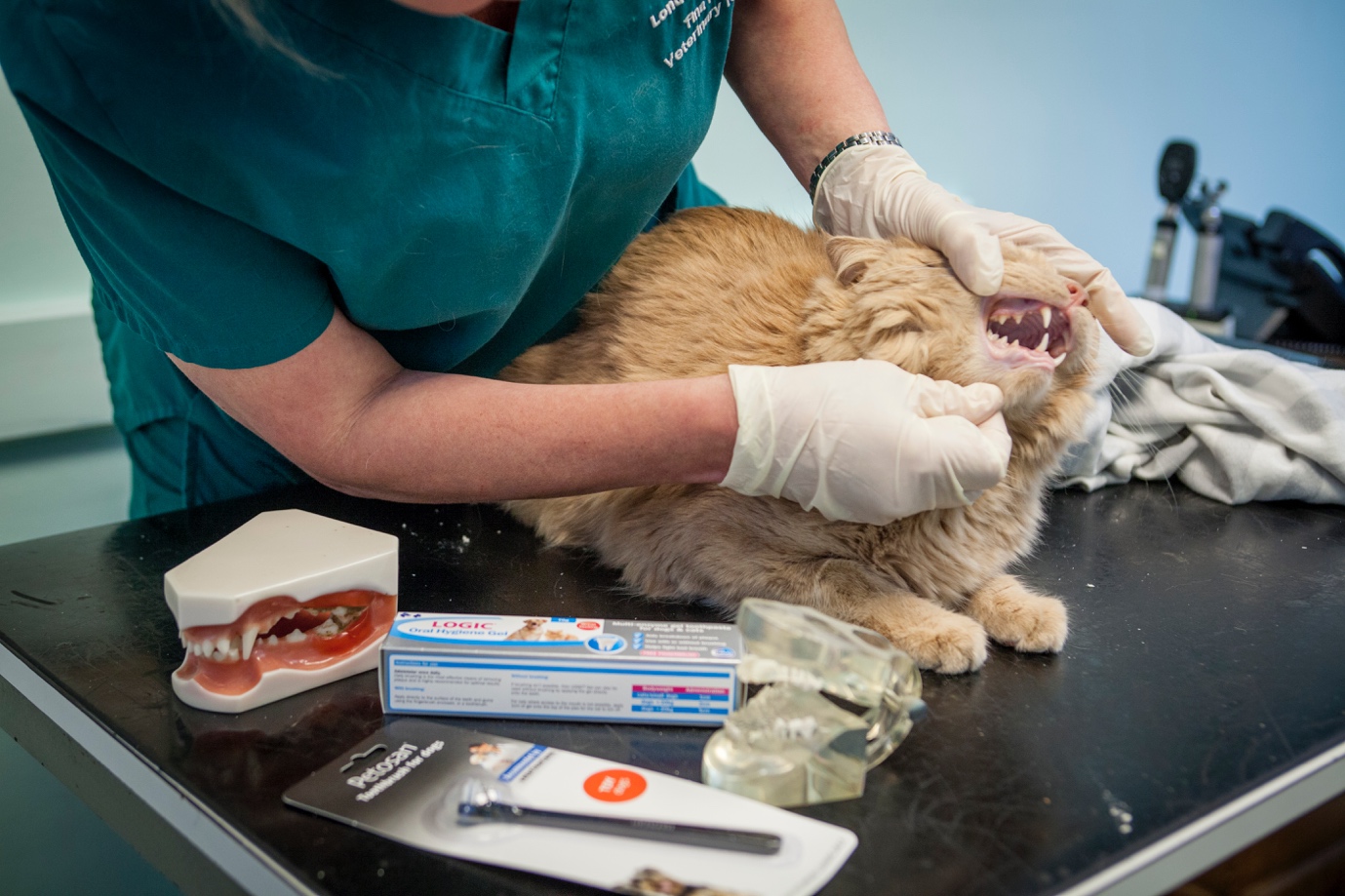
The cats we see at York Street have the good fortune to live in welcoming and secure homes. They have safe places to relax in, caring people to look after them and tasty foods to choose from. Why then do three out of four of the mature cats we see at the clinic have dental disease?
The answer, of course, is us. We’ve selected some breeds like Persians and British Shorthairs for short noses. That crowds their teeth so much they don’t get cleaned well when food is chewed. Even more commonly, most of us give in to our cats’ demands and feed they what they want, not what’s good for them. A street cat eats the hard bits of prey as well as the soft bits. Our pet cats often demand that we feed them soft food, with lots of extra jelly please!
Cats have another dental challenge. Several viruses they may be exposed to at birth or later can cause serious gum inflammation called periodontitis. Once periodontitis develops it is difficult to overcome.
What we commonly see in cats is a milder condition called ‘gingivitis’. This is not caused by viral infections and is easy to reverse. All a cat needs to do is routinely chew on moderately hard food. Some dry food makers claim their foods overcome mild gingivitis. I don’t know if that’s accurate but chewing on real bones is effective. Dogs usually wolf down their food but cats are fastidious eaters and if you give a cat a chicken neck it will slowly and happily demolish it. (I sometimes see a cat that has a chicken bone stuck between its teeth in the roof of its mouth but in 55 years in practice I can’t recall ever seeing a cat that needed a surgical intervention for an intestinal impaction from chicken bones.)
Early treatment saves teeth
Dental disease in cats is insidious and slowly progressive which is why so may well cared for cats have it. It starts as plaque on the teeth. Plaque is an invisible film of bacteria. If this isn’t removed, for example by the abrasive action of eating chicken wings, the plaque hardens into visible yellow-brown tartar. Tooth brushing won’t remove tartar. It can only be completely removed by a proper ‘scale and polish’. If plaque is left, the ligaments that surround and support the teeth can become inflamed. This is ‘periodontitis’ and leads to both pain and tooth loss.
Even more common in the cats we see are tooth ‘cavities’ although unlike with us these cavities are not caused by bacteria so they are given a different technical names, “FORLs” which means ‘feline odontoclastic resorptive lesion’. These are painful. When we see a cat that has become unexpectedly grumpy, the first thing we look at are its teeth and gums. Removing the damaged tooth almost instantly eliminates the associated pain.
At York Street we have a purpose designed dental suite with similar equipment to what you see when you visit your dentist including a wall mounted dental x-ray machine that produces high definition views of tiny tooth roots. Paloma, Ella and Stephen are all experienced veterinary dentists and in the rare occasions where specialist skills or equipment is useful, Dr Peter Kertesz, a dental surgeon with over 40 years experience in animal dentistry sees pets at York Street.
Brushing your cat’s teeth?
If you want to try brushing your cat’s teeth, don’t use human toothpaste. Cats hate it. Use a flavoured cat product, for example one that contains the antiseptic chlorhexidine.
Use a toothbrush, not a ‘finger cot’. You want to avoid being bitten.
Build up trust by first offering the tasty toothpaste as a treat. Place a tiny bit on its nose.
Accustom your cat over a few days to your holding its head up a little while you feed it the toothpaste.
Initially, use a cotton bud to apply a little tasty toothpaste to the teeth, Once your cat accepts that, you can graduate to using the toothbrush.