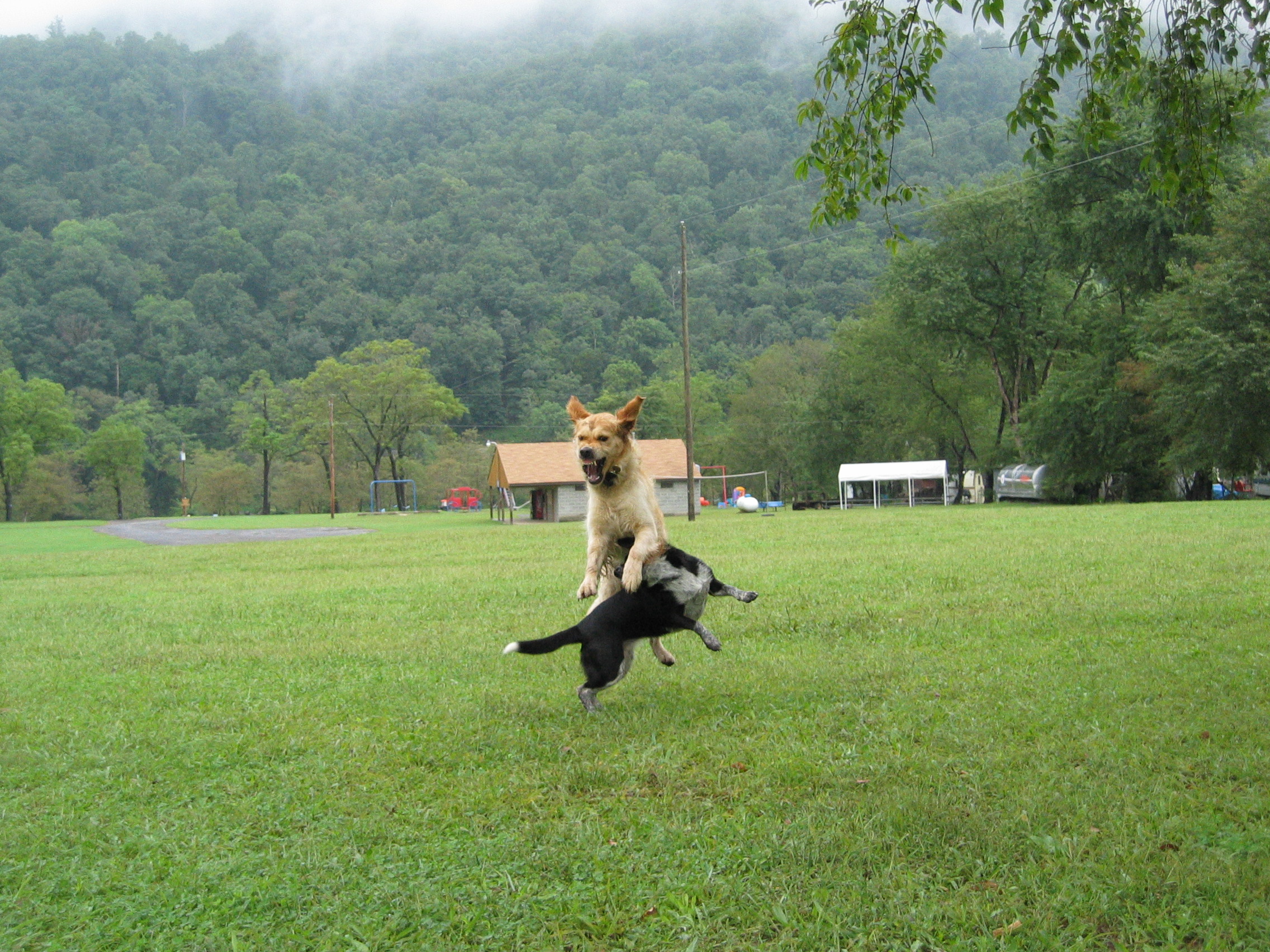
“Sorry!”, I shout from a distance. “My dog has Tourette’s.” This is a daily ritual on The Little Scrubs in North Kensington. My dogs, Plum and Honey, and I arrive at 7 AM. Sparky young Honey races off to say ‘hello’ to any human or dog she sees. Her 12 year old aunt Plum is still remarkably agile. She torpedoes full speed ahead, yelling deep throated menacing barks. According to Guinness World Records, the Golden Retriever has the loudest bark in the dog world. At 113 decibels, Plum is as loud as a thunderous jackhammer.
It’s embarrassing but fortunately my fellow park visitors know Plum. In the bright early sunshine if Carlton is there, hitting the punching bag he’s hung from a tree, he smiles and says, “Hello potty mouth.” Carlton is a dad. He understands silly behaviour from dogs as well as kids. My fellow dog walkers say things like, “Got out of the wrong side of your basket today Plum?”, and, as she runs over to them smiling earnestly with her face and tail, they get out her daily treats.
I confess that I live with an embarrassing dog but others may find it difficult to be truthful with themselves, let alone with friends or neighbours about their pets’ unpleasant behaviours.
This was explained to me by an American cultural anthropologist, Constance Perin, who became fascinated by the behaviour of pet owners while she was carrying out research for her book, Belonging in America.
Connie, born in Pontiac, Michigan, never lived with a pet. The exotic ‘tribe’ she chose to study was ‘middle America’, her own tribe. Raised in a home without pets, in her surveys and interviews with middle Americans she was surprised by how important pets were to how communities functioned. “They are the glue or the solvent of neighbourly relations.” Connie told me. She was so captivated by what she had learned she went off on a tangent and started writing scientific articles on our relationship with pets. That’s how I can across Connie and we first met in 1980.
Here’s a typical scenario that Connie observed. Your free roaming middle American dog canters over to your neighbour’s suburban front lawn and has a dump. Or your meandering cat dumps in your neighbour’s flower bed then digs up the flowers as she buries her poop. Your neighbour asks you to control your dog or cat and you reply, with earnestness, that it couldn’t possibly have been your dog/cat that did such a thing.
Connie observed that three out of four of us lie about our pets’ bad behaviour. Deep down we know we’re lying but we still lie. She asked herself why we do so and in an elegant dive into our subconsciousness she postulated that we can develop what she called a ‘superabundant love’ for our pets, an innocent love that is so strong it’s hard for us to see fault in them.
I know that Plum doesn’t have Tourette’s. Like all dogs, in human terms she’s on the autism spectrum. Plum gets upset by the unexpected – an empty plastic bag blowing along the ground, someone who slows down while walking for no apparent reason, a full moon on the horizon at dawn. She barks because its ‘not right’, it doesn’t fit her understanding of the world around her. I turn her bark into a joke because I don’t want people to be frightened of, or to dislike my dog.
I’ve made a choice to let Plum bark and then to apologise. I get away with that because I know all the other Little Scrubs visitors. But if your dog, or cat, has an unpleasant habit that is damaging neighbourly relations, the London Vet Clinic is perhaps the only GP clinic in London with a Behaviour Service.
While Dr Natalia Bewick, head of the service, is on maternity leave, her colleague Antonella Marsicano, MSc, ABTC-CAB, CCAB, Clinical Animal Behaviourist, is here to meet with you and your companion. Please telephone 02077232068 to book an appointment.